
Labubus and the brainrot aesthetic
Why is everything so ugly and weird looking?
This is the work newsletter of Kyle Chayka. You may know me from my column as a staff writer at The New Yorker; my most recent book, Filterworld; my first book, The Longing for Less; or maybe even IRL. I also run the newsletter One Thing, which is about quality in culture. I post on Bluesky, X, and Instagram.
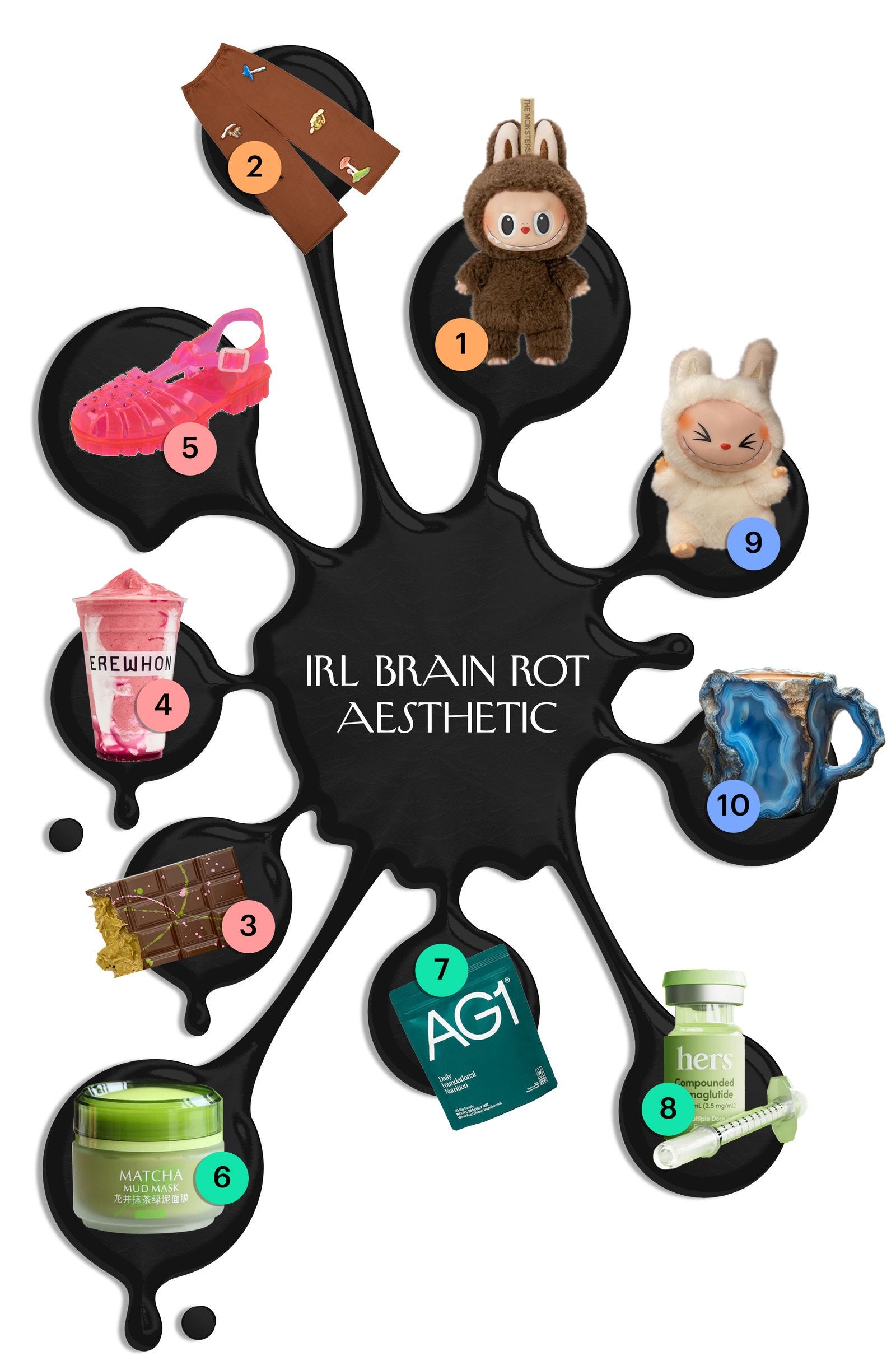
You might have seen the little fuzzy toy monsters around or heard the name Labubu. (I am told they now cost $65 on the black market.) Maybe you’ve seen signs for Dubai chocolate, or a garish new strawberry matcha latte from Starbucks. Or a smoothie that looks like a rainbow cyclone, with some kind of seaweed in it. I think there’s a new Gen Z aesthetic emerging, one that’s often visually ugly or yucky but also freighted with symbolism. I wrote a long-ish essay for The New Yorker about this “IRL Brain Rot” lifestyle and the mutability and mutation of the digital self:
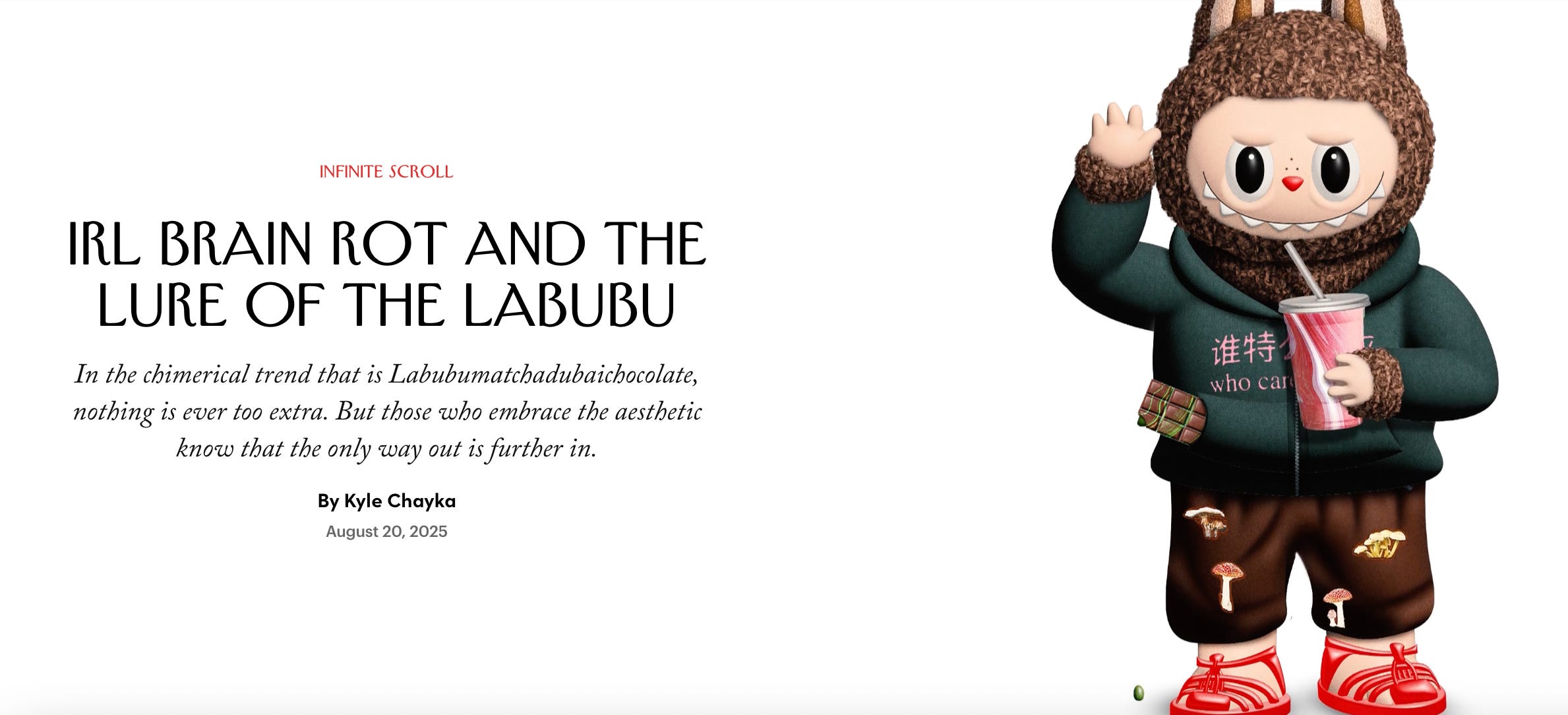
Something I love doing in essay writing is gathering a big group of cultural phenomena and “drawing a circle around it,” as an editor once put it to me — demonstrating how all of these things are connected, responding to the same themes and perhaps anxieties in contemporary life. It’s easy to dismiss youth-culture trends or just see them as capitalistic trash, but I think this slop-adjacent realm of dupe products and Instagrammable potions points to our increasingly desperate need to manipulate our own images, and an acceptance of the fact that we’re kind of hybridized monsters ourselves in this post-A.I. human-machine moment:
These products feel hallucinatory. They take the social-media mandate of self-modification to its logical extreme, embracing easy-breezy chemical additives and image augmentation: enhancing the self until it spills from its pores. The aesthetic is as much a defense mechanism against the internet era as it is a self-aware in-joke: We can see what late-hyper-digital-artificially-intelligent capitalism is doing to us—isn’t it a laugh? “It’s very unnatural-looking,” the cultural critic Dean Kissick told me, describing the dominant visual style of extremely online consumerism. “It kind of relishes its own artificiality.” Any pretense of the pure or organic is undercut by a kind of willful alchemy; everything is an admixture.
In this case, the keystone for me was seeing that the generic drug / beauty brand Hers makes an Ozempic-like semaglutide in packaging the color of matcha, mingling two trends that appear vastly different. One is a green caffeinated beverage and the other is an injection that dampens your desire to consume and helps you lose weight. Yet here they are crashing together, representing a runaway consumerism without a coherent endpoint. It’s magical thinking, which makes sense given the incomprehensibility of our moment. Go read the essay!
Other recent columns
Are You Experiencing Posting Ennui? A column on the decline of mundane content on social media and the lack of a desire to share your life when the rest of the internet is AI slop, bad news headlines, and polished influencers. I was interviewed about this piece a few times, including in a BBC video and Jon Favreau’s Offline podcast. And I made a talking-head video about it for The New Yorker that ironically got over 2 million views on Instagram!
The Revenge of Millennial Cringe A good companion to Labubu brainrot, this column took on the viral clip of Edward Sharpe and the Magnetic Zeros playing an indie stomp-clap song from 2009. Maybe unbridled sincerity is more appealing when everything is so confusing. Made another New Yorker video for this.
A.I. Is Homogenizing Our Thoughts I read through studies and interviewed academics about experiments that prove generative A.I. makes us more generic as writers, thinkers, and communicators. Test subjects who used ChatGPT wrote more like each other, made the same arguments, and used less diverse vocabulary.
Gentle-Parenting My Smartphone Addiction I’ve been using an app called Opal to block social media apps on my phone during the workday, and it’s been working surprisingly well! I had an insightful conversation with the app’s creator.
Donald Trump, Zohran Mamdani, and Posting as Politics Whether it’s negotiations with Ukraine and Russia or the NYC mayoral race, politics is all about what you put out there on social media, the tone of your videos, images, and memes. Mamdani succeeded by adopting the latest TikTok style.
As always please let me know what you think! Or should I just be posting videos of myself summarizing everything I write?? Subscribe to this newsletter with the button below if you don’t already.
I really enjoy your writing and observations. I was recently at a (mostly) silent retreat at a monastery and at a meal where we could talk, most still didn’t. A guy said to me after sitting together for a while quietly, “I think silence is subversive.”
I had been thinking the same thing. In the world of constant communication, chatter, and slop, extended silence feels like a forbidden pleasure.
…can echo the brain rot and overwhelm of slop on all platforms has probably decreased at least 50% of the cadence of peers I grew up with on the web…there is a vaague lingering meaningless to social media…was maybe there all along but with less and less humanity the gulf between utility/joy and nihilism is quite amplified these days…